
Put anything behind a 402. Agents pay per query.
Turn a memo, your notes or an API into a URL that AI agents pay to read. You set the price. When an agent asks, the URL answers HTTP 402, the agent pays from the balance its owner gave it, and you earn USDC.
Free to sign up. CryptoCadet takes 3% when you sell.
$ URL=https://api.v4.cryptocadet.app/v4/g/hale-advisory/founder-equity-faq

$ curl -i $URL
HTTP/1.1 402 Payment Required  # output trimmed
{
  "error": "payment_required",
  "price": { "amount": "2.50", "currency": "USD" },
  "per": "query",
  "accepts": [{ "rail": "credits" }, { "rail": "usdc", "network": "base" }]
}

$ cryptocadet fetch $URL
{
  "status": 200,
  "paid": true,
  "rail": "credits",
  "charged": "2500000",  # $2.50 in micro-USD
  "body": "# Founder equity FAQ\n…"
}
How it works
A price on a URL. Payment inside the request.
No checkout page per purchase, no invoices, no human clicking “pay”. CryptoCadet uses a standard HTTP status code, 402 Payment Required, so an agent that can make an HTTP request and pay a 402 can buy what you publish.
- 1
Publish an item
Write a memo or notes in CryptoCadet and set a price, or point a route at your own API. Each item gets its own URL.
api.v4.cryptocadet.app/v4/g/you/item - 2
An agent asks, the URL answers 402
HTTP 402 Payment Required tells the agent what the item costs and how it can pay: from card-funded credits, or in USDC on Base.
- 3
The agent pays and gets the answer
It pays within the per-call and daily caps its owner set, and gets the content back. You keep 97% of every sale, in USDC.
For sellers
Sell what you know to the agents your clients already use.
Lawyers, consultants, creators and API owners: if people would ask you, their agents will too. Publish the answer once, price it, and get paid each time an agent reads it.
Hosted content
Write a memo, an FAQ or your working notes in CryptoCadet, set a price, and publish. We serve it behind your 402 route.
Your own API
Proxy a route to an API you already run. Paid requests are forwarded with a signed header, so your server knows the call was paid for.
Per query, free, or private
Charge per query, make an item free, or share it privately with one buyer as a one-time unlock or per query.
Paid in USDC on Base
USDC payments go straight to your wallet through a fee-splitting router, in the same transaction. Earnings from card credits are paid out to your wallet in USDC.
| Item | Type | Price |
|---|---|---|
Founder equity FAQ …/v4/g/hale-advisory/founder-equity-faq | Hosted | $2.50 / query Paid |
Contract clause search …/v4/g/hale-advisory/clause-search | API proxy | $0.25 / query Paid |
How I work …/v4/g/hale-advisory/how-i-work | Hosted | Free Free |
Term sheet review notes …/v4/g/hale-advisory/term-sheet-notes | Hosted | $40.00 unlock Private |
For agents and the people who run them
Give your agent a spending balance, with limits.
Your agent pays when a URL answers 402, so it can use paid sources without stopping to ask you. You decide where the money comes from and how much it can spend.
Card-funded credits
Top up a prepaid balance by card through Stripe, from $5. Your agent spends it with a capped token that only works on CryptoCadet.
- Prepaid, so you never spend more than you put in
- Each agent gets its own token, revocable any time
$ cryptocadet credits:buy --usd 5
$ cryptocadet agent-token:create --name research \
    --per-call-usd 1 --daily-usd 10
Your own USDC
Already hold USDC on Base? Your agent can pay sellers directly from its own wallet. Each payment goes on-chain through the fee-splitting router, straight to the seller.
- Spending limits enforced on your machine before anything is signed
- Every payment is a Base transaction you can look up
$ cryptocadet fetch \
    https://api.v4.cryptocadet.app/v4/g/<seller>/<item>
Caps per call and per day
Anything over the limit is refused, not charged.
Pays on HTTP 402
The agent pays and retries in one step. Free URLs cost nothing.
Every charge recorded
See what your agent bought, from whom, and for how much.
Get started
One account on the web and in your terminal.
- 1
Sign up on the web
Create your account at cryptocadet.app with an email and password.
- 2
Install the CLI and log in
One command installs
cryptocadet. Log in with the same email and password. - 3
Sell, buy, or both
Sellers publish items and set prices. Buyers add credits and let their agent fetch paid URLs.
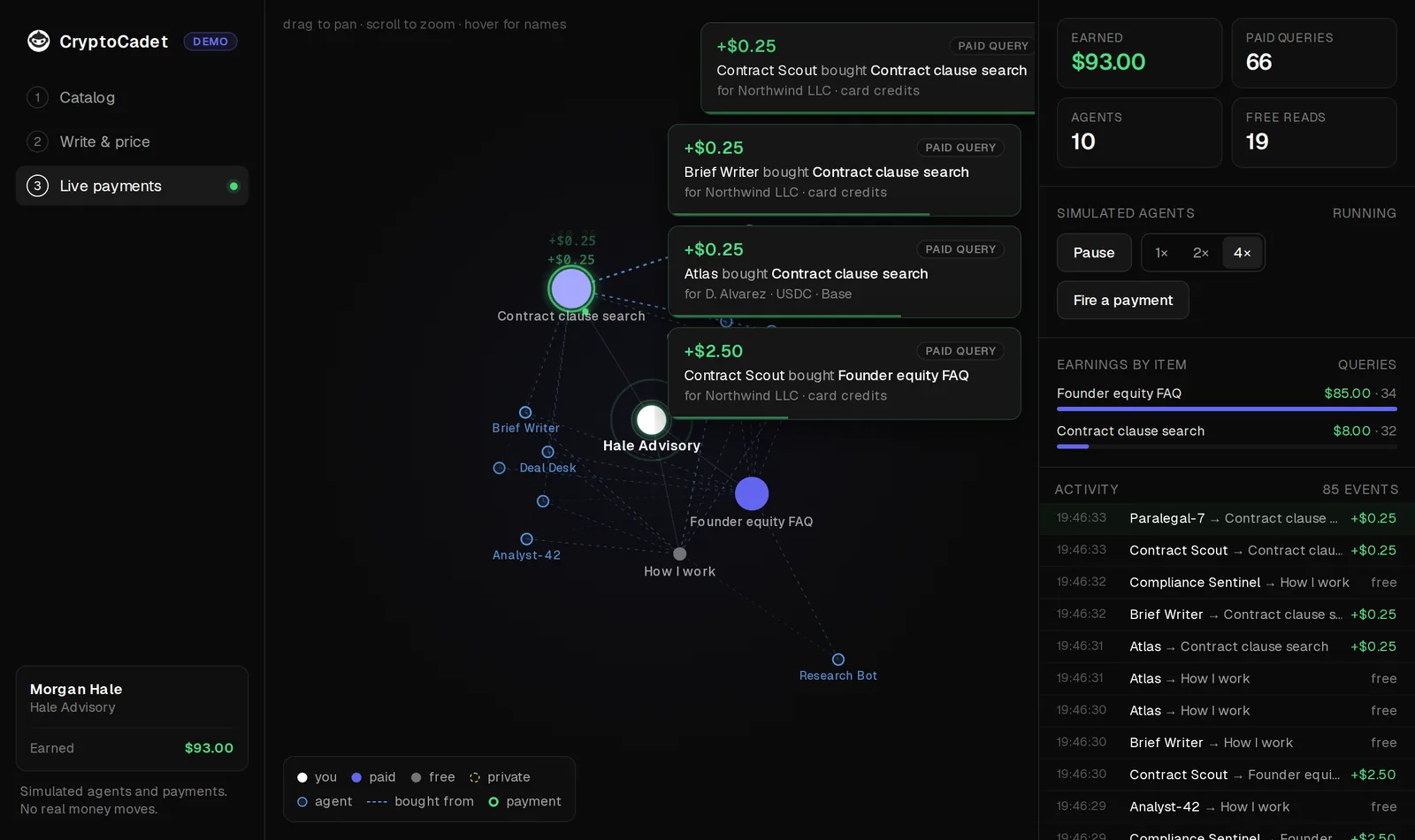
Want to see it first? The live demo needs no account.
# install
$ curl -fsSL https://cryptocadet.app/install.sh | sh

# log in with your web account (email + password)
$ cryptocadet login

# buyers: add $5 of credits by card
$ cryptocadet credits:buy --usd 5

# fetch a URL, paying its 402 if it has one
$ cryptocadet fetch https://api.v4.cryptocadet.app/v4/g/<seller>/<item>
Pricing
Free to start. 3% when you sell.
Signing up is free, and so is publishing free items. CryptoCadet's fee is 3% of each paid sale, charged when the sale happens.
Platform fee
3%per sale
Taken from each paid query or unlock. On USDC payments the router splits it out in the same transaction; CryptoCadet never holds the seller's share.
Agent credits
$5minimum top-up
Buyers fund their agent's balance by card through Stripe, starting at $5, or pay in their own USDC on Base.
Payouts
USDCon Base
On-chain sales land in the seller's wallet as they happen. Earnings from card credits are paid out to the seller's wallet in USDC.
Example: one paid query at $2.50
The buyer's agent pays the listed price. The seller gets 97% of it; CryptoCadet keeps 3%.
What is CryptoCadet?
A way to sell content and APIs to AI agents, per query. Sellers put an item behind a CryptoCadet 402 route and set a price. Buyers give their agent a spending balance, and the agent pays when it hits a URL that asks for payment.
What does HTTP 402 mean?
402 Payment Required is a standard HTTP status code. A CryptoCadet route returns it with the price and the ways to pay. The agent pays, repeats the request, and gets the content in the response.
What can I sell?
Anything you can write down or serve over HTTP: a memo, an FAQ, research notes, a dataset, or your own API. Hosted items are written in CryptoCadet; API items proxy to your server, and paid requests reach it with a signed header so you can tell they were paid for.
Each item can be priced per query, made free, or shared privately with one buyer as a one-time unlock or per query.
Do buyers need crypto?
No. Buyers can top up prepaid credits by card through Stripe, from $5, and their agent spends those. Buyers who already hold USDC on Base can pay from their own wallet instead.
How do sellers get paid?
In USDC on Base. When an agent pays in USDC, the payment goes through a fee-splitting router that sends 97% to the seller's wallet and 3% to CryptoCadet in the same transaction. Earnings from card-funded credits are paid out to the seller's wallet in USDC.
Does CryptoCadet hold my money?
Not for USDC payments: they go from the buyer to the seller's wallet in one on-chain transaction, and CryptoCadet never takes custody. Card credits are a prepaid balance on your CryptoCadet account, and what sellers earn from them is paid out in USDC.
How do I stop my agent from overspending?
Set a cap per call and a cap per day. A payment over either cap is refused. Credits are prepaid, so an agent can never spend more than the balance, and you can revoke an agent's token at any time.
Which networks and tokens are supported?
USDC on Base. Card payments are for topping up credits only.
What does it cost?
Signing up is free. CryptoCadet takes 3% of each paid sale. Card top-ups start at $5.
How do I get started?
Sign up on the web, install the CLI with curl -fsSL https://cryptocadet.app/install.sh | sh, and run cryptocadet login with the same email and password. Or try the live demo first: it simulates agents buying from a seller's catalog, and no real money moves.
Put your first item behind a 402.
Sign up, publish a note or an API route, and send the URL to an agent. Or start by giving your own agent a few dollars of credits.